Renal · USMLE Step 1
Acid-base for USMLE: read any blood gas in four steps
A four-step method for arterial blood gas questions: pH, primary disorder, expected compensation and anion gap, with diagrams and worked practice questions.
Acid-base questions reward a fixed routine. Do the same four steps in the same order every time and you will not miss a mixed disorder, which is what most of these questions are really testing.
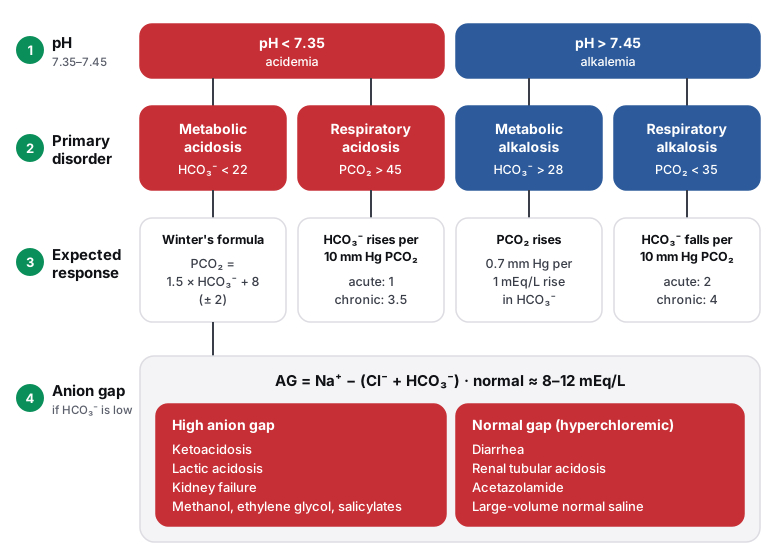
The steps, briefly
- pH. Acidemia or alkalemia. Compensation never fully corrects the pH, so the pH tells you which side the primary problem is on.
- Primary disorder. Ask which value moved in the direction that explains the pH: a low HCO₃⁻ explains acidemia (metabolic), a high PCO₂ explains it too (respiratory).
- Compensation. Calculate where the other value should be. If it is outside that range, there is a second, separate disorder.
- Anion gap. In every metabolic acidosis. It sorts the cause into one of two short lists.
What the anion gap actually means
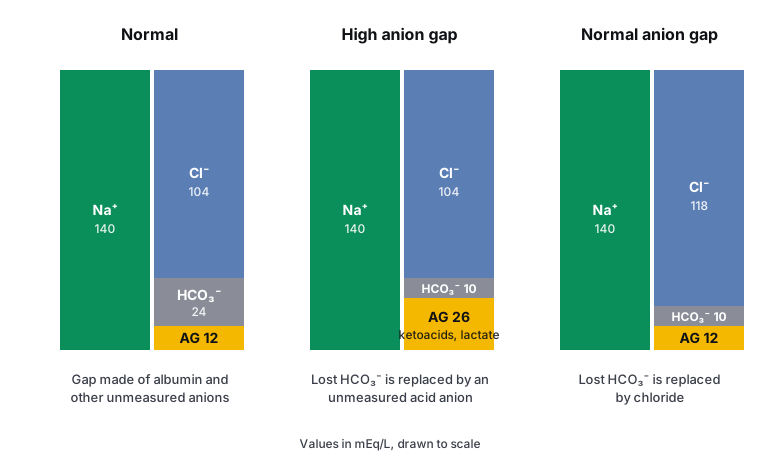
Low albumin hides a high gap, because albumin is most of the normal gap: add about 2.5 mEq/L to the gap for every 1 g/dL that albumin is below 4.
Causes worth knowing
| Disorder | Common causes |
|---|---|
| Respiratory acidosis | Hypoventilation: opioids and sedatives, COPD, neuromuscular disease (myasthenia gravis, Guillain-Barré, ALS), obesity hypoventilation, airway obstruction |
| Respiratory alkalosis | Hyperventilation: anxiety, pain, high altitude, pulmonary embolism, early salicylate toxicity, sepsis, pregnancy |
| Metabolic alkalosis, urine Cl⁻ < 20 | Saline-responsive: vomiting, nasogastric suction, past diuretic use |
| Metabolic alkalosis, urine Cl⁻ > 20 | Saline-resistant: current loop or thiazide use, hyperaldosteronism, Cushing syndrome, Bartter and Gitelman syndromes |
Two extra calculations
- Delta ratio (in a high anion gap acidosis): (AG − 12) ÷ (24 − HCO₃⁻). Between 1 and 2 is a pure high-gap acidosis. Below 1, bicarbonate has fallen more than the gap explains: there is also a normal-gap acidosis. Above 2, there is also a metabolic alkalosis (for example, DKA with vomiting).
- Osmolal gap: measured osmolality − (2 × Na⁺ + glucose/18 + BUN/2.8). A gap above about 10 with a high anion gap acidosis suggests a toxic alcohol: methanol (visual loss) or ethylene glycol (calcium oxalate crystals, acute kidney injury). Treat with fomepizole, which blocks alcohol dehydrogenase, and dialysis if severe. Isopropyl alcohol raises the osmolal gap and causes ketosis but no acidosis.
Renal tubular acidosis (normal anion gap)
| Type | Defect | Urine pH | Serum K⁺ | Associations |
|---|---|---|---|---|
| 1 (distal) | α-intercalated cells cannot secrete H⁺ | > 5.5 | ↓ | Calcium phosphate stones; Sjögren syndrome, lupus, amphotericin B |
| 2 (proximal) | Proximal tubule cannot reabsorb HCO₃⁻ | < 5.5 once HCO₃⁻ is low | ↓ | Fanconi syndrome, multiple myeloma, acetazolamide; rickets |
| 4 | Low aldosterone or aldosterone resistance | < 5.5 | ↑ | Diabetic nephropathy, ACE inhibitors and ARBs, spironolactone, NSAIDs |
Practice questions
Question 1RenalDiabetic ketoacidosis
A 19-year-old woman with type 1 diabetes has vomiting and deep, rapid breathing. Arterial blood gas: pH 7.29, PCO₂ 26 mm Hg, HCO₃⁻ 12 mEq/L. Serum Na⁺ 135 mEq/L, Cl⁻ 100 mEq/L. Which best describes her acid-base status?
A pH of 7.29 is acidemia and the HCO₃⁻ is low, so the primary problem is a metabolic acidosis. The anion gap is 135 − (100 + 12) = 23, which is high (ketoacids). Winter's formula predicts a PCO₂ of 1.5 × 12 + 8 = 26 ± 2, and hers is 26, so the deep, rapid (Kussmaul) breathing is exactly the expected compensation.
A coexisting respiratory acidosis would make the PCO₂ higher than Winter's formula predicts (above 28). Hers is 26, so she is blowing off CO₂ appropriately.
A coexisting respiratory alkalosis would make the PCO₂ lower than predicted (below 24). Hers is within the expected 24–28, so there is no second disorder. (This is the pattern of salicylate poisoning.)
A normal anion gap acidosis has a gap of about 8–12 mEq/L. Hers is 23, which fits ketoacid accumulation, not diarrhea or renal tubular acidosis.
A primary respiratory alkalosis would give an alkaline pH. Her pH is acidic; the low PCO₂ is the response to the acidosis, not its cause.
The answer is A.
Key takeaway
In metabolic acidosis, check Winter's formula (PCO₂ = 1.5 × HCO₃⁻ + 8 ± 2) before calling a second disorder, then calculate the anion gap.
Work through a gas in order: pH, primary disorder, expected compensation, anion gap. Here a low pH and low HCO₃⁻ make a metabolic acidosis, the PCO₂ matches Winter's prediction, and a gap of 23 points to ketoacids. In a young patient with type 1 diabetes and vomiting, this is diabetic ketoacidosis.
- Anion gap = Na⁺ − (Cl⁻ + HCO₃⁻); normal about 8–12 mEq/L
- Winter's formula: expected PCO₂ = 1.5 × HCO₃⁻ + 8 (± 2)
- PCO₂ above the range: added respiratory acidosis. Below the range: added respiratory alkalosis
- High-gap causes: ketoacidosis, lactic acidosis, kidney failure, toxic alcohols, salicylates
Question 2RenalSalicylate poisoning
A 45-year-old man is brought in with tinnitus, nausea and confusion after taking a large number of tablets. Arterial blood gas: pH 7.46, PCO₂ 22 mm Hg, HCO₃⁻ 15 mEq/L. His anion gap is 24 mEq/L. Which disorders are present?
The anion gap of 24 and low HCO₃⁻ do show a metabolic acidosis, but a metabolic acidosis alone would give an acidic pH and a PCO₂ of about 30 (Winter's formula). His PCO₂ is 22 and his pH is alkaline, so a second process is present.
A respiratory alkalosis alone would lower HCO₃⁻ by only about 4–7 mEq/L for this fall in PCO₂, and it would not raise the anion gap. A gap of 24 means there is also a metabolic acidosis.
The HCO₃⁻ is low with a high anion gap: metabolic acidosis. For an HCO₃⁻ of 15, Winter's formula predicts a PCO₂ of 30.5 ± 2. His PCO₂ of 22 is far lower, so there is also a primary respiratory alkalosis, which is why the pH is slightly alkaline. Tinnitus plus this mixed picture is classic salicylate (aspirin) poisoning.
A metabolic alkalosis would have a raised HCO₃⁻ (above 28) and a respiratory acidosis a raised PCO₂ (above 45). His HCO₃⁻ and PCO₂ are both low.
With a respiratory acidosis the PCO₂ would be higher than the 30 predicted for his bicarbonate, and the pH would be acidic. His PCO₂ of 22 is lower than expected.
The answer is C.
Key takeaway
Tinnitus plus a high-anion-gap acidosis with a PCO₂ lower than Winter's prediction is salicylate poisoning: metabolic acidosis with respiratory alkalosis.
Salicylates directly stimulate the respiratory center, causing respiratory alkalosis early, and uncouple oxidative phosphorylation, which produces lactate and ketoacids and a high anion gap acidosis. Winter's formula exposes the mixed disorder: the PCO₂ is far below the predicted value. Treat with IV sodium bicarbonate (to alkalinize the urine) and dialysis if toxicity is severe.
- Clues: tinnitus, nausea, confusion, hyperventilation, fever
- Mixed disorder: high-anion-gap metabolic acidosis plus primary respiratory alkalosis
- Treatment: IV fluids, sodium bicarbonate to alkalinize the urine, hemodialysis if severe
- Activated charcoal if the ingestion was recent
Question 3RenalMetabolic alkalosis
A 30-year-old woman has had persistent vomiting for 5 days. Arterial blood gas: pH 7.52, PCO₂ 47 mm Hg, HCO₃⁻ 37 mEq/L. Serum K⁺ is 2.9 mEq/L and urine chloride is 8 mEq/L. What is the most appropriate treatment?
Acetazolamide inhibits carbonic anhydrase and increases bicarbonate loss in the urine, but it also wastes potassium, and she is already hypokalemic and volume-depleted. Correcting volume and chloride treats the cause.
Furosemide causes more volume and chloride loss, worsens the metabolic alkalosis and lowers the potassium further. Loop diuretics are a cause of this disorder, not a treatment.
Vomiting loses gastric HCl and volume. The volume contraction makes the kidneys hold on to bicarbonate, and the low urine chloride (< 20 mEq/L) shows a saline-responsive alkalosis. Normal saline replaces volume and chloride so the kidneys can excrete bicarbonate, and potassium chloride corrects the hypokalemia. The PCO₂ of 47 is the expected compensation (about 0.7 mm Hg per 1 mEq/L rise in HCO₃⁻).
She already has excess bicarbonate (HCO₃⁻ 37 mEq/L). Giving more base would worsen the alkalosis.
Spironolactone is a potassium-sparing diuretic used in mineralocorticoid excess, which gives a high urine chloride and hypertension (a saline-resistant alkalosis). Her low urine chloride and recent vomiting point to a saline-responsive cause.
The answer is C.
Key takeaway
Metabolic alkalosis with a low urine chloride (< 20 mEq/L) is saline-responsive: give volume, chloride and potassium.
Metabolic alkalosis is divided by urine chloride. Low urine chloride (vomiting, nasogastric suction, past diuretic use) means volume contraction is maintaining the alkalosis, and it corrects with saline. High urine chloride (current diuretics, hyperaldosteronism, Cushing syndrome, Bartter and Gitelman syndromes) is saline-resistant and needs the cause treated.
- Vomiting loses H⁺ and Cl⁻; volume depletion raises aldosterone, which wastes K⁺ and H⁺
- Urine Cl⁻ < 20 mEq/L: saline-responsive
- Urine Cl⁻ > 20 mEq/L: saline-resistant (diuretics, mineralocorticoid excess)
- Expected compensation: PCO₂ rises about 0.7 mm Hg for each 1 mEq/L rise in HCO₃⁻
Go deeper in the Knowledge Hub: acid-base disorders, salicylate poisoning, toxic alcohol poisoning and renal tubular disorders.