Endocrine · USMLE Step 1
Thyroid function tests for USMLE: read TSH and free T4 together
Place any TSH and free T4 result in a nine-box grid, then use the uptake scan to name the cause of hyperthyroidism. Diagrams, traps and practice questions.
Thyroid questions hand you a TSH and a free T4 and expect you to place the patient in one box. Read the two together, never alone, and remember the direction of the feedback loop: the pituitary raises TSH when it senses too little thyroid hormone.
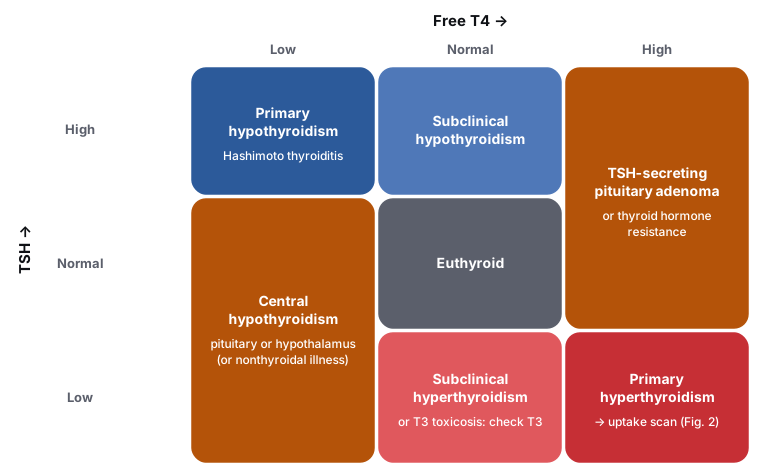
The logic in two lines
- Primary disease (the thyroid itself): TSH moves opposite to free T4. This is almost every case in practice.
- Central disease (pituitary or hypothalamus): TSH is low or inappropriately normal while free T4 is low. A TSH-secreting adenoma does the reverse.
Hyperthyroid? The uptake scan names the cause
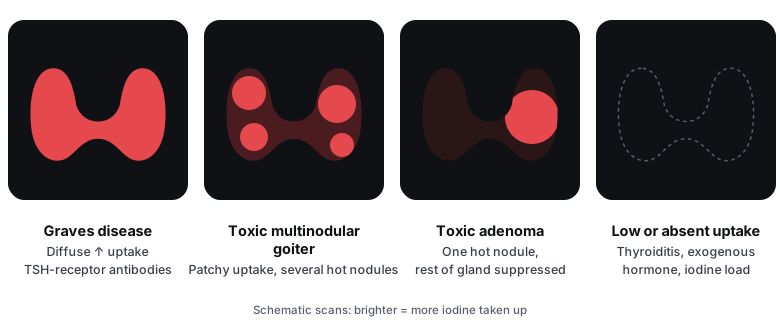
Low uptake has three main causes. Subacute (de Quervain) thyroiditis follows a viral illness and is painful, with a high ESR. Painless or postpartum thyroiditis is not tender. Exogenous thyroid hormone is the one with a low thyroglobulin, because the gland itself is switched off; in thyroiditis, thyroglobulin is high.
Hyper vs hypo at the bedside
| Hyperthyroidism | Hypothyroidism | |
|---|---|---|
| Metabolism | Heat intolerance, weight loss despite good appetite | Cold intolerance, weight gain |
| Heart | Tachycardia, atrial fibrillation, high-output failure | Bradycardia, pericardial effusion |
| Skin and hair | Warm, moist skin; fine hair | Dry, cool skin; coarse hair; periorbital edema |
| Nerves and muscle | Tremor, hyperreflexia, proximal myopathy | Slow relaxation of reflexes, myopathy with ↑ CK |
| Other | Diarrhea, oligomenorrhea, osteoporosis | Constipation, menorrhagia, ↑ LDL, hyponatremia |
Antibodies
- Graves disease: TSH receptor–stimulating antibodies (TSI). They also explain ophthalmopathy and pretibial myxedema, which no other cause of hyperthyroidism has.
- Hashimoto thyroiditis: anti-thyroid peroxidase (anti-TPO) and anti-thyroglobulin antibodies. It can start with a brief hyperthyroid phase, and it raises the risk of thyroid lymphoma.
Treatment essentials
- Methimazole is first-line for hyperthyroidism. Propylthiouracil is used in the first trimester of pregnancy (methimazole is teratogenic then) and in thyroid storm, because it also blocks peripheral T4-to-T3 conversion. PTU can cause severe liver injury; both can cause agranulocytosis (stop the drug if fever or sore throat appears).
- Radioactive iodine is contraindicated in pregnancy and can worsen Graves ophthalmopathy. β-blockers control adrenergic symptoms in every cause.
- Thyroid storm: β-blocker (propranolol), PTU, then iodide at least an hour after the thionamide, plus glucocorticoids.
- Hypothyroidism: levothyroxine, adjusted by TSH 6–8 weeks after each change. Myxedema coma: IV levothyroxine plus hydrocortisone.
Two patterns that fool people
- Sick euthyroid (nonthyroidal illness): in serious illness, T3 falls and reverse T3 rises, while TSH is normal or low. The thyroid is fine; do not treat.
- Thyroid nodule: check TSH first. If TSH is low, do an uptake scan; a "hot" nodule is rarely malignant. If TSH is normal or high, do an ultrasound and fine-needle aspiration based on its features.
Practice questions
Question 1EndocrineGraves disease
A 32-year-old woman has weight loss, heat intolerance, palpitations and bulging eyes. Her TSH is suppressed and free T4 is high. A radioactive iodine uptake scan shows diffusely increased uptake. What is the mechanism of her disease?
Blocking antibodies reduce thyroid hormone production and can cause hypothyroidism. Her TSH is suppressed and her free T4 is high, so the gland is being stimulated, not blocked.
Diffuse uptake plus eye disease is Graves disease, caused by IgG antibodies (TSI) that stimulate the TSH receptor, driving unregulated hormone synthesis. TSH is suppressed by negative feedback. The same antibodies act on orbital fibroblasts (ophthalmopathy) and dermal fibroblasts (pretibial myxedema).
A toxic adenoma shows a single hot nodule with suppression of the rest of the gland, not diffuse uptake, and it does not cause eye disease.
Destruction of follicles (subacute or painless thyroiditis) releases preformed hormone, but the damaged gland takes up almost no iodine, so uptake is low.
A TSH-secreting pituitary adenoma would give a high or inappropriately normal TSH with a high free T4. Her TSH is suppressed.
The answer is B.
Key takeaway
Hyperthyroidism with diffuse increased iodine uptake and eye disease is Graves disease: TSH-receptor-stimulating antibodies.
Graves disease is autoimmune. Thyroid-stimulating immunoglobulins bind the TSH receptor and make the whole gland overactive, so uptake is diffuse and high and TSH is suppressed. The same antibody process explains the eye and skin findings, which no other cause of hyperthyroidism produces.
- Triad: hyperthyroidism, ophthalmopathy, pretibial myxedema
- Labs: low TSH, high free T4; uptake scan diffusely increased
- Treatment: methimazole (PTU in the first trimester and thyroid storm), β-blocker for symptoms, radioiodine or surgery
- Radioiodine can worsen ophthalmopathy and is avoided in pregnancy
Question 2EndocrineSubacute thyroiditis
A 41-year-old woman has a painful, tender neck and palpitations 2 weeks after a sore throat. Her TSH is low, free T4 is high, ESR is 78 mm/h, and radioactive iodine uptake is very low. What is the most appropriate treatment?
Methimazole blocks hormone synthesis. In thyroiditis the gland is not overproducing: stored hormone is leaking out of inflamed follicles, so blocking synthesis does nothing.
A tender thyroid after a viral illness, a high ESR and low uptake is subacute granulomatous (de Quervain) thyroiditis. Treat the symptoms: a β-blocker for the palpitations and NSAIDs (or glucocorticoids if severe) for the pain. It usually resolves on its own.
Radioiodine works by being taken up by the gland. Uptake here is very low, so it would not be effective, and the condition is self-limited.
Surgery is not needed for a transient, self-limited inflammatory condition.
Levothyroxine is for hypothyroidism. She is thyrotoxic now; a hypothyroid phase can follow, but it is usually mild and temporary. Giving thyroid hormone to a thyrotoxic patient would make things worse.
The answer is B.
Key takeaway
A tender thyroid after a viral illness with a high ESR and low uptake is subacute thyroiditis: treat symptoms with a β-blocker and NSAIDs.
In subacute (de Quervain) thyroiditis a viral-associated inflammation damages the follicles and releases stored hormone. The thyroid is not overactive, so uptake is low and antithyroid drugs are useless. The course is a thyrotoxic phase, then a hypothyroid phase, then recovery, over weeks to months.
- Tender thyroid after a viral illness; high ESR; low uptake; granulomas on histology
- Course: thyrotoxic phase → hypothyroid phase → recovery
- Treat symptoms: β-blocker and NSAIDs (glucocorticoids if severe); no antithyroid drugs
- Painless (silent or postpartum) thyroiditis follows the same course without tenderness
Question 3EndocrineThyrotoxicosis factitia
A 29-year-old nurse has palpitations, tremor and weight loss. TSH is suppressed and free T4 is high. Radioactive iodine uptake is low, the thyroid is not tender or enlarged, and serum thyroglobulin is low. What is the most likely cause?
Graves disease shows increased uptake, and thyroglobulin is normal or high because the gland is making hormone.
Painless thyroiditis also shows low uptake, but thyroglobulin is high because the damaged follicles release it. Her thyroglobulin is low.
Struma ovarii (thyroid tissue in an ovarian teratoma) is a rare cause of low neck uptake, but thyroglobulin is typically high because functioning thyroid tissue is making hormone. A low thyroglobulin points to a suppressed gland.
Low uptake narrows it to thyroiditis, exogenous hormone, or (rarely) ectopic production. A low thyroglobulin is the key: the gland is suppressed and releasing nothing, so the hormone is coming from outside: surreptitious levothyroxine use (thyrotoxicosis factitia). Healthcare workers and people trying to lose weight are classic patients.
A toxic adenoma shows a single hot nodule on the scan, often a palpable nodule, with normal or high thyroglobulin. Uptake would not be low.
The answer is D.
Key takeaway
High free T4 with low uptake and low thyroglobulin means the hormone is coming from outside the gland: surreptitious levothyroxine use.
Low uptake with a suppressed TSH means the thyroid is not making the hormone. Thyroglobulin then separates the causes: it is high in thyroiditis (damaged follicles release it) and low in exogenous hormone use (the suppressed gland releases nothing). A normal neck examination and access to thyroid medication complete the picture.
- Low uptake with high free T4: thyroiditis, exogenous hormone, struma ovarii, iodine load
- Thyroglobulin: high in thyroiditis, low in exogenous hormone
- Examination: no goiter, no eye disease
- Stop the hormone and recheck thyroid tests; address the reason for the use
Go deeper in the Knowledge Hub: hyperthyroidism and thyrotoxicosis, hypothyroidism, Graves disease and subacute thyroiditis.